STUDY SHEETS for May 24, 2015

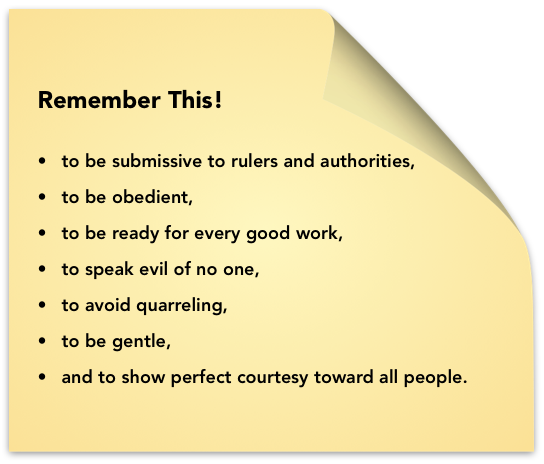
sticky note remember this Titus 3-1-2

Hello Everyone,

Happy Memorial Day weekend to you! We remember and we honor on this weekend.

Can I be a blessing to God and country?

More specifically … Can I be a blessing to God and to my country without compromising the truth of God’s word?

The answer is a “definite yes” but we must have a truly God-first, biblical approach to life.

Our text today in Titus 3 presents a life-style that transcends any government, society or culture and is pleasing in the sight of God. Do you want to be a blessing to the King of the universe and the government in which you live, then here is a “plan” for you.

Message Title: Remember This!

Message Text: Titus 3:1-11

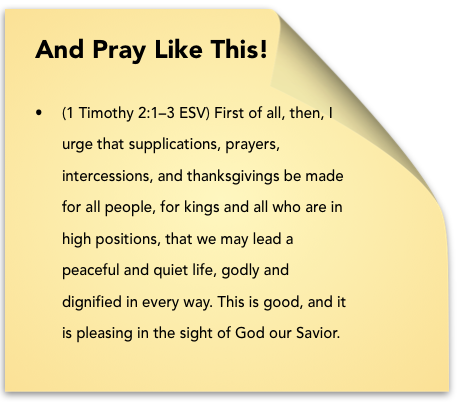
sticky note pray like this 1 Timothy 2-1-3

Message MP3 for Sunday May 17, 2015


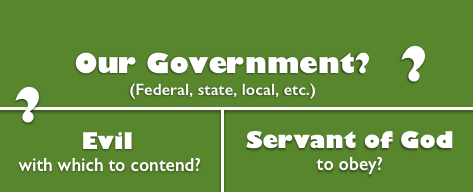
our government evil or God's servant

Is our government an evil with which to contend or God’s ordained servant?

Dear Friends,

So where are the battles that God would define? It is interesting to note our seeming obsession at times with government reform, but where might we go in Scripture to even find a solid reference to support this, let alone justify the time, resources and energy spent in battling the evil in government.

What we need to answer is this:

What does God say?

Not “what we say God says” but:

What does God say?

Not “this is how we believe” or “this is the evangelical voice” but:

What does God say?

On our relationship with our government he is very clear: submit to the governing authorities. Respect them. Honor them. God has put them in place for his purpose and plan. Our lack of submission, our dishonor, our disrespect all reflect a disobedient heart before God.

There is a kingdom of peace, quiet, godliness and dignity in which we can thrive, even under adverse government authority.

It begins here with the Word of God: Submit to the governing authorities.

Message Title: Governing Authorities: Servants of God

Message Text: Romans 13:1-7


MORE STUDY SHEETS for Sunday May 17, 2015

whose kingdom come whose will be done

Here is a question that is on the minds of many Christians, and, actually,
for many Christians this is not a question at all but a moral imperative.

–Should a Christian be involved in secular government?–

Hello Everyone,

Should we run for office? Should we support a right-wing agenda?
Should we lobby our legislative bodies of government? Etc. 

To some it is a non-issue, but to many people this is the “hot topic” of their lives.

But Romans 13:1-7 does not speak to our involvement in government but with our relationship to government, as do Matthew 22:15-22, John 18:33-36, 1 Timothy 2:1-3, Titus 3:1-11 and 1 Peter 2:13-17.

And since I am preaching through Romans this will be “the headline.”

  • (Romans 13:1–7 ESV) Let every person be subject to the governing authorities.

If I were to preach on our involvement in government, I would go to … Well, let’s see … Hmmmm …. Not sure where I would go. Seems to be a lack of direct communication “in the Bible” on this topic. Not that this often slows us down. 🙂

If I were to address the subject of civil disobedience, I would look at the Old Testament books of Daniel and Esther, but even there I believe the people pushing a right-wing “Christian” agenda would be disappointed if we look at what God actually says.

In these supplemental study sheets, I do give more background as to the historical, cultural setting for Paul’s instruction to us. Albert Barnes gives an excellent overview, and as always John MacArthur adds his insight which is always grounded in the Word of truth.

Here is a question that should have our attention:

Are my actions and attitude toward a leftist, liberal, gay [fill-in-the-blank] agenda
putting my mind and heart in opposition to God’s agenda?

And with the direction I have chosen in this matter:

Am I more or less secure and at peace in God’s sovereign and providential rule?

And one more:

Is my biblical/political stance yielding the fruit of a peaceful,
quiet, good, thankful, godly and dignified life pleasing to God?

PS Also decided this morning that we are going to spend two weeks in this and related texts. Next week is Memorial Day weekend, so it seems very appropriate.

STUDY SHEETS for Sunday May 17, 2015

governing authorities building angel wings halo

“It is only a slight exaggeration to say that the history of the interpretation of Romans 13:1–7 is the history of attempts to avoid what seems to be its plain meaning” (Douglas Moo).

Hello to You,

And welcome to Romans 13:1-7, one of the most controversial passages in the Bible. And there is our key.

“In the Bible …”

I have been thinking through this text for weeks now, anticipating, sometimes almost dreading, our arrival here. But not now. God did something a while back.

He said, “Dave, what does it say? What is the headline? Preach the headline. Preach the words plainly stated, clearly written, and I will be pleased.”

So I am asking you. What does it say? Let’s begin here.

  • (Romans 13:1–7 ESV) Let every person be subject to the governing authorities. For there is no authority except from God, and those that exist have been instituted by God.

So what does God say? It is “in the Bible,” so what does God tell us “in the Bible” as he begins to instruct us on our relationship with those in authority over us?

Submit to, be subject to, etc. depending on our translation. Same meaning, same problem.

  • “But our government has passed this legislation.” “We are no longer honoring God in our legislative system.” “We’ve taken prayer out of the schools.” Righteous indignation, etc.

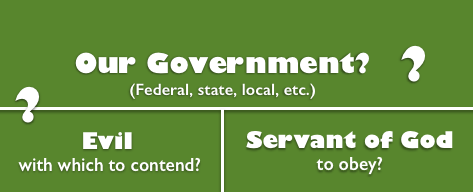
So will we honor God by taking him at his word? Is our government evil to contend with or God’s servant? What does God say? Three times in our text God calls the people in government over us his ministers or servants. (See the study sheets for more details.)

If we trust God as Sovereign LORD and providential Ruler of the Universe, then we have a wonderful opportunity of blessing to trust him here.

Whatever position you decide to take as you approach this text, you may want to ask yourself this question: Is my study (or my protests or my hypotheticals) bringing me closer to obedience of this very plain truth or taking me further away?

And there you have it. It’s “in the Bible.” Will you study and gather information that directs you to hear the voice of God or will you throw in with the many evangelical and fundamentalist voices that blur the clearly written truth and spew dishonor and fear.

  • Let every person be subject to the governing authorities.

Message Title: Governing Authorities: The Servants of God!

Message Text: Romans 13:1-7

our government evil or God's servant


Romans 13:1 … Albert Barnes …

Let every soul – Every person. In the seven first verses of this chapter, the apostle discusses the subject of the duty which Christians owe to civil government; a subject which is extremely important, and at the same time exceedingly difficult. There is no doubt that he had express reference to the special situation of the Christians at Rome; but the subject was of so much importance that he gives it a “general” bearing, and states the great principles on which all Christians are to act. The circumstances which made this discussion proper and important were the following:

  • The Christian religion was designed to extend throughout the world. Yet it contemplated the rearing of a kingdom amid other kingdoms, an empire amid other empires. Christians professed supreme allegiance to the Lord Jesus Christ; he was their Lawgiver, their Sovereign, their Judge. It became, therefore, a question of great importance and difficulty, “what kind” of allegiance they were to render to earthly magistrates.
  • Nor was the case much different with the “Gentile” converts. They would naturally look with abhorrence on the system of idolatry which they had just forsaken. They would regard all as opposed to God. They would denounce the “religion” of the pagans as abomination; and as that religion was interwoven with the civil institutions, there was danger also that they might denounce the government altogether, and be regarded as opposed to the laws of the land,
  • The kingdoms of the world were then “pagan” kingdoms. The laws were made by pagans, and were adapted to the prevalence of paganism. Those kingdoms had been generally founded in conquest, and blood, and oppression. Many of the monarchs were blood-stained warriors; were unprincipled men; and were polluted in their private, and oppressive in their public character. Whether Christians were to acknowledge the laws of such kingdoms and of such men, was a serious question, and one which could not but occur very early. It would occur also very soon, in circumstances that would be very affecting and trying. Soon the hands of these magistrates were to be raised against Christians in the fiery scenes of persecution; and the duty and extent of submission to them became a matter of very serious inquiry.
  • Many of the early Christians were composed of Jewish converts. Yet the Jews had long been under Roman oppression, and had borne the foreign yoke with great uneasiness. The whole pagan magistracy they regarded as founded in a system of idolatry; as opposed to God and his kingdom; and as abomination in his sight. With these feelings they had become Christians; and it was natural that their former sentiments should exert an influence on them after their conversion. How far they should submit, if at all, to heathen magistrates, was a question of deep interest; and there was danger that the “Jewish” converts might prove to be disorderly and rebellious citizens of the empire.
  • There “were” cases where it was right to “resist” the laws. This the Christian religion clearly taught; and in cases like these, it was indispensable for Christians to take a stand. When the laws interfered with the rights of conscience; when they commanded the worship of idols, or any moral wrong, then it was their duty to refuse submission. Yet in what cases this was to be done, where the line was to be drawn, was a question of deep importance, and one which was not easily settled. It is quite probable, however, that the main danger was, that the early Christians would err in “refusing” submission, even when it was proper, rather than in undue conformity to idolatrous rites and ceremonies.
  • In the “changes” which were to occur in human governments, it would be an inquiry of deep interest, what part Christians should take, and what submission they should yield to the various laws which might spring up among the nations. The “principles” on which Christians should act are settled in this chapter.


This is the only work God wants from you …

Jesus told them, “This is the only work God wants from you: Believe in the one he has sent.”

And this is the will of God, that I should not lose even one of all those he has given me, but that I should raise them up at the last day. For it is my Father’s will that all who see his Son and believe in him should have eternal life. I will raise them up at the last day.”

‭‭John‬ ‭6:29, 39-40‬ ‭NLT‬‬
http://bible.com/116/jhn.6.29,39-40.nlt

Sent from my iPad