
STUDY SHEETS for Sunday – December 11, 2016

The church at Laodicea is another on our list of very impressive churches. Just ask them.

  • (Revelation 3:17a ESV) For you say, I am rich, I have prospered, and I need nothing …

But we get a different impression as we read the words of the Amen, the faithful and true witness, the beginning of God’s creation.

  • (Revelation 3:17 ESV) … not realizing that you are wretched, pitiable, poor, blind, and naked.

Our glorified Lord calls them wretched. We could also have named them the pitiful church, the rich but poor church, the blind church or the naked church.

We even could have named this church the Goldilocks Church as they liked their spiritual porridge not too hot, not too cold, but just right. They would have called it balanced; Jesus called it lukewarm. Which brings me to another name for that church. The “I Would Spit You Out of My Mouth” Church. Jesus said that because they were lukewarm that he would spit them out of his mouth.

Message: “The Wretched Church!”
Message Text: Revelation 3:14-22


AUDIO for Sunday – December 4, 2016

open-bible-keep-word-not-deny-name

REVELATION MESSAGE 9: Philadelphia–The Church of the Open Door
Revelation 3:7-13

What service or duty or work might God ask of a little church?

  • What are his expectations? I mean, if you think about it, how could a church small in size, with limited resources and little influence do anything meaningful in the cause of Jesus Christ?
  • Let’s not kid ourselves. Let’s face reality. No idealistic silliness or fanciful speculations. No human boasting and wishful thinking. Let’s talk about life in the real world, the bottom line, what matters.
  • But as we do this we shouldn’t  stop at only what we can perceive or understand on our own as mere humans. Why stop there when we all know that reality extends far beyond this world? So let’s not limit ourselves or restrict ourselves to our human theories and notions.
  • What if we had someone who could speak ultimate reality to us? What if this morning, right now, we could hear from Someone who is the very essence of ultimate reality of both this world and the next?

STUDY SHEETS for Sunday – December 4, 2016

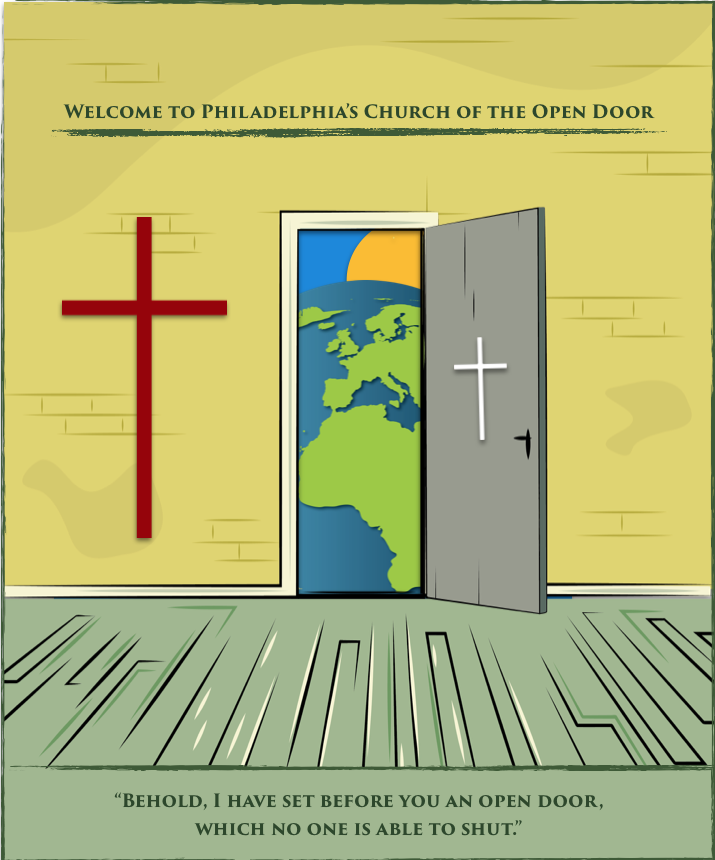
welcome-church-open-door-front-cover-earth-doorway

What does it mean that they have kept his word and have not denied his name?

What is this open door that Christ has set before them?

Message: “Philadelphia–The Church of the Open Door!” 
Message Text: Revelation 3:7-13


“You have kept my word and have not denied my Name.”

(Revelation 1:3 ESV)

Blessed is the one who reads aloud the words of this prophecy, and blessed are those who hear, and who keep what is written in it, for the time is near.

(Revelation 22:7 ESV)

And behold, I am coming soon. Blessed is the one who keeps the words of the prophecy of this book.

(Revelation 22:9 ESV)

But he said to me, “You must not do that! I am a fellow servant with you and your brothers the prophets, and with those who keep the words of this book. Worship God.”

(Matthew 24:35 ESV)

Heaven and earth will pass away, but my words will not pass away.

(Mark 8:38 ESV)

For whoever is ashamed of me and of my words in this adulterous and sinful generation, of him will the Son of Man also be ashamed when he comes in the glory of his Father with the holy angels.

(John 5:24 ESV)

Truly, truly, I say to you, whoever hears my word and believes him who sent me has eternal life. He does not come into judgment, but has passed from death to life.

(John 8:31 ESV)

So Jesus said to the Jews who had believed him, “If you abide in my word, you are truly my disciples.”

(John 8:37 ESV)

I know that you are offspring of Abraham; yet you seek to kill me because my word finds no place in you.

(John 8:43 ESV)

Why do you not understand what I say? It is because you cannot bear to hear my word.

(John 8:51 ESV)

Truly, truly, I say to you, if anyone keeps my word, he will never see death.

(John 12:48 ESV)

The one who rejects me and does not receive my words has a judge; the word that I have spoken will judge him on the last day.

(John 14:23 ESV)

Jesus answered him, “If anyone loves me, he will keep my word, and my Father will love him, and we will come to him and make our home with him.”

(John 14:24 ESV)

Whoever does not love me does not keep my words. And the word that you hear is not mine but the Father’s who sent me.

(John 17:6 ESV)

I have manifested your name to the people whom you gave me out of the world. Yours they were, and you gave them to me, and they have kept your word.

(John 17:17 ESV)

Sanctify them in the truth; your word is truth.

(1 John 2:4–5a ESV)

Whoever says “I know him” but does not keep his commandments is a liar, and the truth is not in him, but whoever keeps his word, in him truly the love of God is perfected.

AUDIO for Sunday AM – November 27, 2016

sardis-alive-but-dead-building-zombie-signs

The ancient city of Sardis …

  • … was a somewhat notorious city which Sir William Mitchell Ramsay, the noted Scottish archaeologist and New Testament scholar, described as “more like a robber’s stronghold than an abode of civilized men.” 
  • Paige Patterson writes that “in the cities of Asia Minor, no city was as legendary as Sardis.” 
  • Gordon Fee adds that: Of the seven cities to whose churches these letters are written, Sardis easily outstrips the others in terms of its antiquity and well-known history.
  • And Warren Wiersbe tells us that: Ancient Sardis, the capital of Lydia, was a most important city. It lay about fifty miles east of Ephesus at the junction of five main roads; so it was a center for trade. It was also a military center, for it was located on an almost inaccessible plateau. The acropolis of Sardis was about 1,500 feet above the main roads, and it formed an impregnable fortress.
  • Sardis was some kind of town. And the church in Sardis to which our letter in Revelation 3 is addressed was some kind of church. As it was with the church at Ephesus, if you were thinking about moving to Sardis around AD 95-96, this vibrant church would definitely have been on your radar.
  • They had made quite a name for themselves. Whatever they were doing—which in today’s terms would be outreach, marketing, social media, needs-based programs—must have been the right things because they had built a reputation in the area as a church that was alive.
  • Except it wasn’t. The church members were dead. It was a church of dead people.

—>The church at Sardis had three great needs:

  • They needed to realize that they were dead.
  • They needed to be brought to life.
  • They needed to embrace the vision of an overcomer.

REVELATION MESSAGE 8 – Sardis – The Alive but Dead Church
Revelation 3-1-6


  • 64 Ramsay, The Letters to the Seven Churches, 354.  Patterson, P. (2012). Revelation. (E. R. Clendenen, Ed.) (Vol. 39, p. 118). Nashville, TN: B&H.
  • [Patterson, P. (2012). Revelation. (E. R. Clendenen, Ed.) (Vol. 39, p. 118). Nashville, TN: B&H.]
  • Fee, G. D. (2011). Revelation (p. 44). Eugene, OR: Cascade Books.
  • Wiersbe, W. W. (1996). The Bible exposition commentary (Vol. 2, p. 576). Wheaton, IL: Victor Books.

STUDY SHEETS for Sunday – November 27, 2017

sardis-alive-but-dead-front-cover-people

They had the gospel wrong.
No other reason Christ would say they were dead.

The church at Sardis was dead because they had the gospel wrong. Why would I say this? Because the gospel is the only thing that makes dead people alive. If your gospel does not make you alive, then your gospel is false. You still have a gospel, just not the one that saves and makes you alive.

  • The life of a church is not determined by activity, size, location, demographics, denomination, programs or worship style. There is one deciding factor—the gospel. Dead or alive? Works or grace? If the church has the gospel wrong, then the church is dead.

— 2 Choices 1 Gospel —

Choice #1: Grace
Choice #2: Works

Which Gospel?
Grace or Works | Life or Death | Heaven or Hell

  • Works are works, whether one work such as water baptism or many works, it’s all the same, an aberration from the gospel, a deviation from grace, whether Hinduism, Humanism, Buddhism, Catholicism, Protestantism.
  • When a person filters the teaching of Scripture through the natural mind, he or she will always choose works over grace … because grace comes from the mind of God and the concept of works comes from the mind of fallen humans.
  • (Ephesians 2:8–9 ESV) For by grace you have been saved through faith. And this is not your own doing; it is the gift of God, not a result of works, so that no one may boast.

REVELATION MESSAGE 8 – Sardis: The Alive but Dead Church!

Revelation 3:1-6

sardis-believe-in-jesus-too-kind-of

AUDIO for Sunday AM – November 20, 2016

christs-design-intent-architects-chair-drawings-etc

Tolerance.

  • Tolerance is defined as “a fair, objective, and permissive attitude toward those whose opinions, beliefs and practices differ from one’s own.” One dictionary I consulted went so far as to define tolerance as “being patient, understanding and accepting of anything different.”

    As you well know, the concept of tolerance is a very real issue in our world today. It is highly valued, treasured and taught—formally and informally—in our political systems, our schools and universities and in every corner of the workplace. Tolerance is a dominant social value. Some would in fact view tolerance as the glue that holds a society together, the oil that keeps the wheels turning, the benchmark by which all other character traits should be measured, the distinguishing quality of a truly good person.

    Tolerance is a real problem in our world.

    But tolerance is not just a problem in the world. Tolerance is also a problem in the church, in our times, and in ancient times in the church of Thyatira. We would say an age-old problem, going as far back as Adam and Eve’s rebellion in Genesis three.

    So in a dramatic and intentional contrast to a world which practically worships at the throne of tolerance, as Jesus Christ introduces himself to the church in Thyatira, and to us this morning, he doesn’t come from a position of tolerance but from a position of supreme authority and the exacting judgment of a Sovereign Lord. And he commands John to write

Thyatira: The Loving, Faithful, Serving, Enduring but Tolerant Church!
Revelation 2:18-29

AUDIO for Sunday AM – November 20, 2016

STUDY SHEETS for Sunday – November 20, 2016

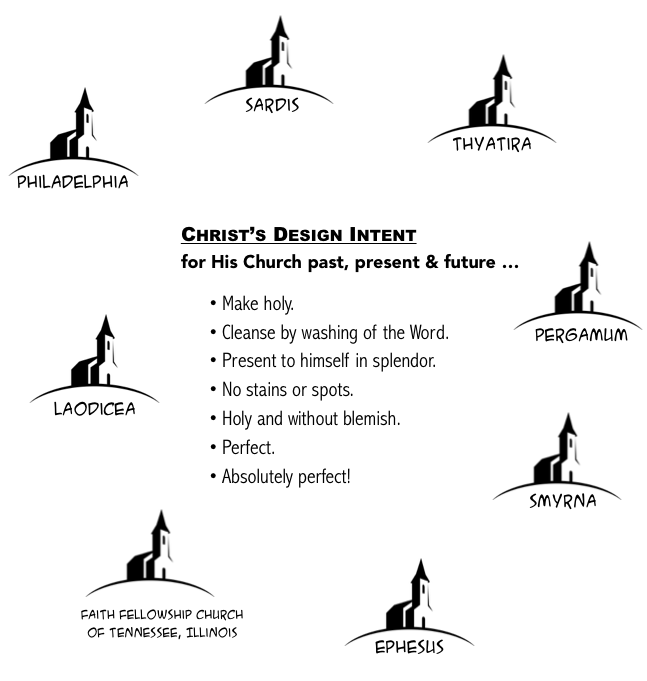
christs-design-intent-past-present-future-churches

Jezebel: Profile of a False Teacher …

  • A false teacher presumes position (Revelation 2:20).
    Jezebel was self-anointed and self-proclaimed. Jezebel “calls herself a prophetess and is teaching and seducing my servants to practice sexual immorality and to eat food sacrificed to idols.” No calling or commissioning necessary for the false teacher. She presumed that she was a person who could speak for God to God’s people.
  • A false teacher has special knowledge (2 John 9).
    A false teacher presumes to have special knowledge, as in being one who better understands the secrets of true spirituality. Jezebel considered herself to have greater spiritual perception than most and, equipped with this special knowledge, she goes beyond the direct, objective confirmation of the Bible. Her ideas and opinions are untethered by Scripture. In Jezebel’s case this special knowledge was “the deep things of Satan” and this special insight enabled her to reach past the constraints of Scripture. As a false teacher she would use the Bible but would not be limited by the Bible.
  • A false teacher is a fixer (Ezekiel 13:10).
    The people in Thyatira had a real problem, and Jezebel fixed it. If the members of this fellowship completely fulfilled their obligation to the trade unions, then they would violate the teaching of Scripture and jeopardize their standing in the church. But if they wholeheartedly obeyed the word of God and refused to take part in the idolatry and the sex that was part of the idolatry, then they would jeopardize their jobs. Jezebel “fixed” this by increasing the tolerance levels of idolatry and immorality past the prescribed levels approved in Scripture. Problem solved.
  • A false teacher brings death and destruction (2 Peter 2:1).
    The wide road always leads to destruction. Always. There is no other destination for someone on the wide road. We may be incredulous as to how these people fell into such blatant sin, and in doing so we would reveal our own faulty standards. We would make the mistake of judging one sin or “indiscretion” above or below another. How? Because in doing this we would reveal our reliance on our own personal man-made standard of compliance. The deceived person believes that their “tolerance levels” are acceptable, even if they are not aligned with the word of God. Simply stated: “Your sin is worse than their sin.”

“Thyatira: The Loving, Faithful, Serving, Enduring but Tolerant Church!”

Revelation 2:18-29